
Cracking your own neck once in a while is usually harmless, but doing it habitually or with a lot of force can be risky, and it rarely addresses why your neck feels tight in the first place. That constant urge to self-crack is often a sign of an underlying joint or posture issue. For Colleyville patients, a professional adjustment targets the specific restricted segment, which self-cracking simply cannot do.
Why Your Neck Feels Like It “Needs” to Crack
That tight, stuck feeling usually comes from restricted joints in the neck, spots where the segments are not moving the way they should. Your body wants relief, so you twist your neck until you hear a pop and feel a brief release.
The relief is real, but it is also temporary. Understanding why it fades so fast is the key to this whole question.
Is Self-Cracking Actually Dangerous?
An occasional, gentle self-adjustment when you turn your head is generally not something to worry about. The concern is with habitual or forceful cracking, especially the aggressive high-velocity twisting some people do many times a day.
Done repeatedly and forcefully, self-cracking can gradually overstretch the ligaments that stabilize your neck, which can lead to too much motion in certain segments over time. Very forceful twisting of the neck also carries a small but real risk to the blood vessels that run through the cervical spine. The point is not to frighten anyone, but to be honest that cranking hard on your own neck many times a day is not the harmless habit it feels like.
The Real Problem: You’re Moving the Wrong Joint
Here is what most people have never been told. When you crack your own neck, you cannot isolate the specific joint that is actually restricted. Instead, the segments that already move well are the ones that give and pop, while the genuinely stuck joint stays stuck.
That is exactly why the urge comes back within twenty minutes or so. You relieved pressure around the mobile joints, but the restricted one never moved, so the tight feeling returns. Over time, repeatedly moving the already-loose segments while the stiff one stays put can make the imbalance worse.
How a Professional Adjustment Is Different
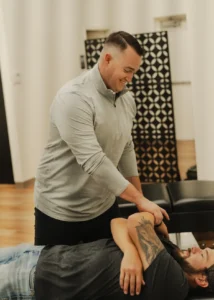
A chiropractic adjustment starts with an exam that identifies which specific segment is restricted. From there, the adjustment is directed precisely at that joint rather than wherever your neck happens to give. That precision is the whole difference.
At our Colleyville office, the technique is matched to you. If you are nervous about a manual adjustment, the Activator Method uses a low-force instrument with no twisting or popping at all. Our comparison of Diversified, Thompson Drop, and Activator techniques explains how those options work, and you can learn more about the process on our chiropractic care page.
Breaking the Habit for Good
Since the urge to self-crack usually traces back to an underlying issue, addressing that root cause is how you actually stop needing to. Often the culprit is neck pain driven by forward head posture, muscle tension, or restricted joints that need targeted correction. Fix the source, and the constant tightness tends to fade on its own.
A Common Myth Worth Clearing Up
The belief that self-cracking is a fine substitute for professional care is one of several misconceptions we hear regularly. Our post on common myths about chiropractic care tackles a few more of them.
Frequently Asked Questions
Will cracking my own neck cause arthritis?
There is no clear proof that occasional cracking causes arthritis, but habitual, forceful self-cracking can irritate joints and encourage instability over time, and it never addresses the underlying restriction.
Why does the urge to crack come back so quickly?
Because you moved the joints that already move well, not the one that is actually stuck. The restricted segment stays restricted, so the tight feeling returns.
Is a chiropractic adjustment safer than self-cracking?
For most people, yes. An adjustment follows an exam and targets the specific joint that needs it, rather than relying on random twisting to find relief.
Do I need a referral to get my neck evaluated?
No referral is needed. You can book directly for an assessment.
Get Real Relief Instead of a Temporary Pop
If you are cracking your neck all day just to feel normal, there is a better answer. Schedule an exam or call 682-343-6801 and let’s find out what your neck actually needs.